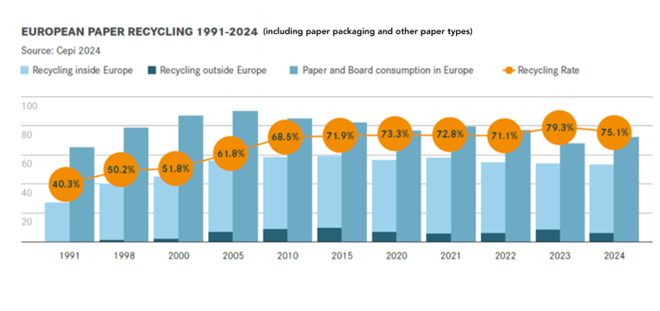
Triggered by the EU’s 2019 Single Use Plastics Directive, Europe’s market for packaging has accelerated a movement towards ‘paperisation’, the trend of replacing fossil-based packaging, particularly plastics, with recyclable paper. Today, paper and board packaging is well-established as a preferred solution for sustainably-minded consumers and producers, while paper mills have continuously increased the use of ‘recycled fibre’ in their raw material mix. So much that now other world regions are also coveting this valuable European resource.
Papermakers, packaging producers and recyclers in Europe aim to reach by 2030 a 90% ‘recycling rate’ for paper-based packaging. The current recycling rate for paper packaging in Europe, standing at 87% according to Eurostat, already exceeds legal EU recycling targets set for the end of the decade, as well as surpassing recycling rates in any other part of the world.
This achievement is the result of a process in which Cepi has played a proactive role, in close coordination with the whole pulp and paper value chain, including waste management companies and fast-moving consumer goods producers. A year after the publication of the Single Use Plastics Directive they have launched together the 4evergreen alliance, spearheaded by Cepi, and involving some of the largest and best-known companies globally. Cepi has further supported this by developing the widely adopted Cepi recyclability test method and encouraging the creation of a European network of testing laboratories using the method. All these initiatives have also set important groundwork for an ongoing standardisation of ‘design for recycling criteria’ as part of the implementation of the EU’s Packaging and Packaging Waste Regulation (PPWR).
Even before these regulatory-focused efforts, European paper packaging companies were reaping the rewards of sizable and sustained investments in their capacity to recycle, and reduce waste, at scales never reached before. They had created large new markets based on the principles of ‘circularity’. For more than a decade, the amount of paper and board packaging recycled has been higher by weight than what is recycled by all other packaging materials combined,and recycled paper has become essential to the functioning of vast parts of Europe’s economy which rely on paper packaging to distribute and sell their products.
But in the last two decades, other geographies have started competing for what is increasingly seen as a precious resource. Per the EU’s ‘Waste Shipment Regulation’, exports of recyclable waste are allowed exceptionally, and are limited to countries and installations able to demonstrate that their operating standards are equivalent to the European Union’s. Europe has a strategic advantage in doing so: the new EU Bioeconomy Strategy published last November aims to strengthen European leadership in bio-based materials. With paper being one of the most used such materials, the new strategy’s ambitious objectives only reinforce the urgency to keep circulating ‘recycled fibre’ in the EU, helping it to stay at the forefront of the paperisation of packaging.